Showing posts with label Los Angeles. Show all posts

Monday, December 2, 2024

Unionism, Los Angeles, 1934-1979


In recognition of Labor Day.
1. United Airlines ground workers on strike, July 1968.
Photo by Ralph Crane.
2. The Brown Derby waiters strike of 1934, when waiters were being paid 90 cents a day and were asking for a base of $15/week. This strike lasted three months.
3. The International Ladies’ Garment Workers’ Union pickets nonunion dressmakers during the Biltmore Bowl, Jan. 18, 1940.
4. Red car operators picketing during a Pacific Electric Railway strike in 1943.
5. My all-time favorite: the lone picketer who stopped work at the Park La Brea construction site on Sept 15, 1949. More than 2,000 tradespeople refused to cross.
6. Carpenters Union on strike in 1949, looks like Gower with Columbia Studios on the left.
7. Striking workers review their growing “Scab Gallery,” during a Douglas Aircraft strike in Long Beach in 1952. Photo by George Silk.
8. César Chavez marches with farm workers during the five-year Delano grape strike that led to the formation of the United Farm Workers Union. Photo by Ernest Lowe, taken March 15, 1966.
9. “The longer the picket line, the shorter the strike.” Also taken by Lowe during the grape strike - March 16, 1966.
10. Disneyland’s maintenance on strike, taken March 7, 1979. In total, 500 workers marched from 14 different unions.
—
Sources: 1,7. LIFE Magazine; 2,4,5,10. @lapubliclibrary; 3,6. @uclalibrary; 8,9. UC Merced.

Sunday, June 30, 2024

Taylor Yard, Los Angeles


1966, View of Southern Pacific Taylor Yard, looking south. Elysian Heights is visible on the right side of the photo and San Fernando Road is at the extreme left. The Purina Chow checkered mill is visible on the left side of the image. (William Reagh Collection)  https://buff.ly/4eZYJUa.  Thanks to the LAPL.

Compare the Taylor Yard pic above to this shot of the Cornfield Yard closer to Chinatown.

More pics from Flicker.
This shot of the Cornfield Yard you can see downtown, whereas the view of DTLA from Taylor Yard is blocked by Elysian Park.  

1964, Southern Pacific's Los Angeles freight yard, adjacent to Chinatown, N. Broadway, and the Civic Center. Workers can be seen in the foreground, unloading lumber onto a truck. (William Reagh Collection) https://buff.ly/4cWmU4k.  

The photos along with the captions come from Water and Power.  

1936, View showing a locomotive wheel change in the shop.  
Photograph caption dated January 27, 1936, reads, 
Passenger Engine No. 7856 of the Union Pacific rolled into the Los Angeles shops for a new set of tires.  Workmen at the shops lifted the 200-ton locomotive from its wheels.  August C. Roepke, mechanical supervisor, second from right, signals crane operator while J. H. Sinnar, foreman of the shop, extreme right, oversees operations and makes certain that workmen are careful and in the clear in case of accident.
1953, View of the roundhouse in operation at the Southern Pacific Taylor Yard, Los Angeles, CA.
The photograph caption, dated April 18, 1953, reads, This is the Southern Pacific's old roundhouse near the Los Angeles River.  It's a far cry from Dieselvill, which is a sprawling yard.  In the roundhouse, locomotives are stacked in stalls like silver stallions.  On the turntable is the Dinky, a snubnosed beetle on an engine which pushes the "biggies" hither and yon.  'There still is romance in steam,' said one veteran railroader.
1940, View of Railroad men on top of a boxcar learning hand signals at the Southern Pacific Yard.


1937, Southern Pacific Coast Daylight, engine number 4410, engine type 4-8-4,  Photographed by Otto Perry on July 27, 1937.
The Coast Daylight was a passenger train run by the Southern Pacific Railroad between Los Angeles and San Francisco, California.  The train ran on SP's coastline tracks which were considered to be the most beautiful route of all their passenger trains.  The passenger cars and locomotive were painted red, orange, and black.  The colors were so striking against the California coastline that the train was often called the "Most Beautiful Train in the World."  
The streamlined daylight began running on March 21, 1937.  Initially, 12 Pullman passenger cars were hauled by GS-2 steam locomotives.  Later, more passenger cars and newer steam engines were added as ridership increased.  A southbound train in San Francisco (Train 98n and a northbound train Los Angeles (Train 99) would leave at the same time.  Both would depart at 8:15 a.m. and arrive at their destination at 6:00 p.m. traveling 471 miles in 9 hours and 45 minutes.
After the inaugural run, the Coast Daylight became very popular and ridership skyrocketed.  Within a few years, the Coast Daylight had the highest ridership numbers in the country.  Almost every day the trains operated at full capacity.  SP placed in order for more streamlined cars, and when they received the new equipment in 1940 they turned the Coast Daylight into the Morning Daylight, which ran with 14 cars.  The older 1937 cars from the Coast Daylight became the mid-day train called the Noon Daylight.  Also, streamlined was the Sunbeam (Texas Daylight), the San Joaquin Daylight which ran through California Central Valley between Oakland and Los Angeles, and the Lark, which ran between San Francisco and Los Angeles at night.
1940, Southern Pacific Noon Daylight, engine number 4428, engine type 4-8-4.  Photographed in Los Angeles, CA on August 1, 1940.
The Noon Daylight was introduced on March 30, 1940, due to demand for travel on the morning Coast Daylight (San Francisco to Los Angeles), however, people preferred the earlier arrival times of the Morning Coast Daylight and patronage did not meet expectations.  The Noon Daylight was discontinued for the World War years, and not reinstated until April 14, 1946.
In the 1950s, train ridership started to decline.  More people were driving cars, flying with the airlines, or even riding rival passenger trains like the Santa Fe.  On January 7, 1955, the steam era ended for the Coast Daylight, and all trains were pulled by diesel engines though the diesels were more efficient, popular opinion felt they just did not have the appeal of a steam engine.
As ticket sales continued their downward spiral, the Daylight trains became shadows of what they had once been, giving way to shrinking and consistently Spartan amenities whenever possible.  The trains were discontinued by the SP. 
1940, Southern Pacific Sunset Limited, engine number 4414, engine type 4-8-4, photographed in Los Angeles by Otto Perry on August 1, 1940.
In 1940, the Sunset was an overnight train SF to LA that continued to New Orleans.  The SF to LA part ended 1942.
The Daylight, Southern Pacific’s original train that later became an entire fleet, was one of the most successful and recognized streamliners of all time even, rivaling the Santa Fe’s legendary Super Chief.  Interestingly, however, only one was a long distance train as the rest were regional runs which served several different Californian cities. The popularity of the train remained incredibly high for many years even through the early 1960s.  However, by the latter half of that decade the Southern Pacific began greatly reducing services and amenities on its fleet as patronage declined.  By that time the railroad grew increasingly disinterested in operating passenger trains resulting in its fabled Daylight fleet coming to an unceremonious end in the early 1970s. Today, a version of this successful fleet of trains remains under Amtrak as the popular Coast Starlight.^

Switchyard Taylor Yard.


1955, View of the shop at Southern Pacific's Taylor Yard with two SP power units and a Union Pacific car on the left.  
1950, View of Taylor Yard showing cars speeding by as the humpmaster [here (5 mins) and here] watches from his tower.

Monte Sano Hospital, Los Angeles, CA 1933.

View of ex-PE MCL PCC car, outbound at Monte Sano, Los Angeles, CA, 1954. 


Monte Sano was California's first osteopathic hospital, built in 1923 and closed sometime in the 1970s. According to The Merger M.D.s & D.O.s in Early California, Monte Sano was "envisioned as the perfect recuperation resort on its hill of health."
It was located at 2834 Glendale Blvd. (at Waverly), Silver Lake.

I have no information on this photo yet other than it was identified [at the center-right of the photo] as the Monte Sano Hospital in Glendale. 

Monday, June 17, 2024

Hyperion Avenue Bridge, Los Angeles, 1932

1932, Hyperion Avenue Bridge, Los Angeles.  Thank you to Historic Los Angeles. 

1935, Hyperion Bridge.

1950s, View showing the eastern end of Glendale-Hyperion Bridge where it swoops down over Riverside Drive near Glendale Boulevard in the Atwater District. 
2015, Rendering of a new pedestrian bridge across the Los Angeles River with the Glendale-Hyperion Bridge seen on the left.  

1938, #Atwater and #Glendale 1938 Los Angeles River flooding capture the Glendale/Hyperion bridge.  Thanks to It's All About NELA Baby. 

Monday, June 10, 2024

2nd Street Tunnel, Los Angeles

1921, View showing the 2nd Street Tunnel construction site before the boring of the tunnel from the Figueroa Street side (western portal).  The multi-story building at the upper right is the Stanley Hotel and Apartments.  


1924, * - Grand opening of the 2nd Street Tunnel on July 25, 1924. A procession of dignitaries awaits the start of the parade while police on horseback maintain crowd control.

The 2nd Street Tunnel in Los Angeles is probably the most recognizable city landmark most Americans have never heard of.  The tunnel--a 1,500-foot-long bore lined with white tile, like a bathroom that never ends--has been used as an exterior in dozens of films and TV shows, most famously in the sci-fi masterpiece, Blade Runner.  Thanks to Water and Power Associates.

1950s, View looking east toward the west end of the 2nd Street Tunnel.  The Stanley Hotel and Apartments stand above the tunnel on Bunker Hill.  In the distance can be seen the dome of the Dome Hotel and Apartments on the SW corner of 2nd and Hill streets.  Bunker Hill would soon be scraped clean to make way for "redevelopment."


1950s, Close-up view of the east of the 2nd Street Tunnel, showing the deterioration of the neighborhood's boarding houses and residential hotels.  California State Library.

1955, Looking east on 2nd Street towards Hope Street, 1955.  Thank you to Los Angeles History.  See the City Hall tower in the background at the left.  Posted on Friday, December 13, 2024.  

1968, View looking east toward the west end of 2nd Street Tunnel as seen from the southwest corner of 2nd and Figueroa.  Bunker Hill Tower, completed in 1968, is seen near the tunnel.  Photo courtesy of Classic Hollywood / Los Angeles / SFV.

Tuesday, March 19, 2024

The Herald-Examiner Building, Los Angeles, 1937

1906, The Los Angeles Examiner.  Founded in 1903 and merged with the Herald Express in 1962 until its closing in 1989.  Thanks to Historic Pictoric.  The Examiner does have an online archive.  Free trial.  


1915, Cover of Los Angeles Examiner on March 20, 1915.


1937, View looking north on Broadway towards Eleventh. Julia Morgan designed the Mission-Revival style Herald-Examiner Building (1111 South Broadway) which opened in 1914. In 1962 the Morning Examiner (founded in 1903) merged with the Evening Herald Express (founded approximately 1871) creating the Herald-Examiner newspaper. The building was designated Los Angeles Historic-Cultural Monument #178 in 1977 and closed in 1989. (Herman J Schultheis Collection) https://buff.ly/3TEpiWC.  Thank you to LAPL Photo Collection.  Today it's home to Arizona State University.  

1937, Exterior view of the Examiner newspaper building, located at 1111 South Broadway, and was designed by architect Julia Morgan. (Works Progress Administration Collection).  Thank you to LAPL.

1976, View of the Mission Revival style Herald-Examiner Building located at Broadway and 11th Street in downtown Los Angeles. Photo by William Reagh.

Completed in 1914, the block-long Herald Examiner Building was commissioned by newspaper magnate William Randolph Hearst to house his Los Angeles Examiner newspaper. Designed by pioneering architect Julia Morgan, the first woman licensed to practice architecture in California, the building blends Mission Revival and Spanish Colonial Revival styles. This project marked the first collaboration between Hearst and Morgan, preceding their more famous work on Hearst Castle in San Simeon. Today, the Herald Examiner Building houses Arizona State University's California Center, along with retail, dining, and event spaces.  Thank you to Jack Feldman.  Find more pics of the Herald-Examiner Building @ Water & Power.  

Saturday, March 2, 2024

The Hall of Justice, Los Angeles, 1925-


1951, Looking north on Broadway with the Hall of Justice on the right.  (Herald Examiner Collection)  https://buff.ly/LPy1iai.  Thank you to LAPL. Posted Tuesday, March 4, 2025.


Sunday, December 10, 2023

The Plaza Church on Main Street across from the Plaza and Olvera Street, 1925


Circa 1925 The Plaza Church on Main Street across from the Plaza and Olvera Street.  Behind the streetcar is the Hotel Pacific, the office of Philip Morici & Company, "Agencia Italiana," and the grocery store of Giovanni Piume, who also made wine (Piuma Road in Malibu was named for him.)  The area north of the Plaza was at this time an Italian neighborhood.

What impressed me about this photo is the caption that says that the area north of the Plaza was at this time an Italian neighborhood and that got me to thinking about the different Italian businesses over there, like Little Joe's, San Antonio Winery, and the the Italian neighborhoods over by Lincoln High School.  I had an Italian lunch one time with Dad at the San Antonio Winery.  The tables were decorated with checkered red-and-white cloth, and a candle in a Chianti bottle.  Dean Martin's "That's Amore" was playing, and I got to enjoy an exclusive hour with my father, one of the few members of the family who enjoyed talking about the past to give me a glimpse of his times, as he put it, the best days.

Tom Donovan Texaco Station @ Sunset and Figueroa


This might be the best shot of that intersection at Figueroa and Sunset in Los Angeles.  That gas station, I believe, is a Gilmore Gasol, where Tom Donovan's old Texaco station used to be in the 1960s.


Caption reads, "(1924)  View looking east toward the intersection of Sunset Boulevard and Figueroa Street.  A Gilmore service station can be seen on the NE corner.  The Orsini Apartment Complex is now situated at this site."

Note the street-level Silverwoodsbill board on the east side of the Gilmore Gasol property.  Silverwoods is where Dad used to shop for clothes in their store on Lake Avenue in Pasadena.  

An interesting note about Gilmore Service stations.  
Built in 1935, this Art Deco gas station was designed by R.J. Kadow, and was one of the original service stations for the Gilmore Oil Company. The Gilmore family is a longtime Los Angeles institution, having acquired the Rancho La Brea in the mid 19th century. In the early 20th century, oil discoveries on Gilmore land brought about a new fortune in petroleum. The Gilmore family went on to establish Farmer’s Market (HCM #543), which was built alongside the original Gilmore Adobe. They also established the Gilmore Bank, built Gilmore Field for the Hollywood Stars, a minor league baseball team, and also sponsored midget race cars on a small race track. Both the field and the racetrack were later replaced by CBS Television Central. The Gilmore Station itself remained with the company until its merger with Mobile Oil in the 1940s. The station was later leased by Texaco, and today serves as a hand-car-wash facility and movie set.

Thursday, June 14, 2012

Cornfield Railyard & Foot Bridge, Los Angeles

Cornfield Railyard today is called Los Angeles State Historic Park.

Let's start with an overview.  [BTW, this is a decent archive of the railyard.]

If you want help orienting yourself with the old downtown LA, the picture below is not terrible.  This shot, I believe, is 1938, so it's pre-Dodgers Stadium.  That broad road left of center is Hill Street.  The street to its right is Broadway, where Little Joe's was located and Dad's favorite Chinese restaurant, Grand Star [looks like it's a jazz club today], where he'd have lunch and a cocktail with friends from work during lunch.  I'd gone with him a few times and loved it.  They seemed to put out on the table slightly fresher Fortune Cookies.  It was my introduction to film noir.  The street at the far right that farther up curves to the right is Spring Street.  It forms the southern border of the Cornfield Trainyard.    I didn't have much experience there, except for when we touched down on the southern end of that pedestrian bridge from Broadway.  I remember that Dad used to tell me that he'd cross that bridge, then cut down another street to get to Maimi's.  Loved that story.   

1938, If you look close enough, you can see the footbridge at about the middle of the photo and to the far right.  You can see it, too, in this pic that is looking northeast.  Will never forget how Dad enjoyed the San Antonio Winery [few more pics] over there in Lincoln Park.  I had gone there a few times, at least twice with Dad.  Once Dad and I sat in their dining room and had Italian dinners on a red-and-white checkered tablecloth while they played Dean Martin's "That's Amore."   

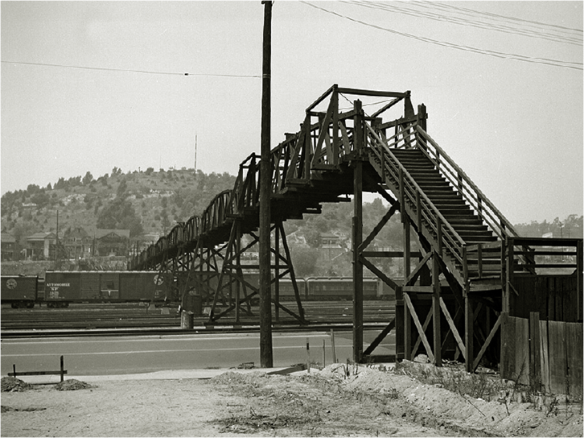
This is the footbridge that Dad used to take me, Tom, and Joe across whenever we were in the area, either after a Dodger game or after an afternoon at the Police Academy or after a half-day spent with Dad in his courtroom getting caught up on his paperwork on a Saturday.  Or it could have been after a morning of strolling down Olvera Street, getting a colorful snow cone, or standing around a burro and a cart for a picture in the plaza there.  On the north end of the footbridge is Broadway and on the south end is Spring Street.  
 

Here is the southern end of the footbridge.  Grateful to LA Creek Freak for the picture.  That is Spring Street there.  


Below is a distant shot of the footbridge that you can see beyond the parked cars.  I love it.  


But the bridge didn't just make for a route for my Dad from school to Maimi's, it was also his playground, like so much of LA was.  From that bridge, he would jump down onto moving train cars in the yard.  See for yourself what that could have been like. 


1942, This is a screenshot from the 1942 movie, This Gun For Hire, starring Ladd and Lake.  That's Alan Ladd jumping from the pedestrian bridge down onto movie train cars.  This is what Dad used to do. 


1957, A decent shot of Cornfield Yard looking into Downtown from the very east end of the yard, 1957.  Thanks to LAPL.

1957, Cornfield  Rail Yard, Los Angeles, CA.  Thank you to Mel-v VC.

A close-up of Ladd preparing to jump. 
1942, Screenshot from the 1942 film noir, This Gun For Hire, starring Alan Ladd and Veronica Lake.  Interesting to learn that the movie was based on a novel by Graham Greene who I like a lot.  Ladd plays the character Philip Raven, who'd been double-crossed (aren't they all?) and his honeypot in the movie is none other than Veronica Lake.  

The scene above comes from the 1942 film noir, This Gun for Hire, starring Alan Ladd and Veronica Lake.  It's a classic film noir, and if you like Alan Ladd at all, in movies like Shane (1953), then you'll love This Gun For Hire.  It rents for $4.  

1942's This Gun for Hire isn't the only movie that contains scenes from the footbridge over the old Cornfield Yard.  The 1954 The Big Chase, starring Lon Chaney, Jr. is seen running across the bridge too.  

I posted this picture because my dad would take Tom and Joe, and me and park at the curb of the eastbound side of Broadway, directly in front of that pedestrian bridge that used to run over the yard to Spring Street on the south side.  We used to run across this bridge, before and after they added the reinforcing chain link fence, sometimes in the late afternoon of a Sunday evening following a Dodgers game.  Or, on more than a few occasions, Dad would take us in the evening and into the night and run across it.  At the 1:28 mark in the clip above, you can see the scene in question; it offers a fuller view of the bridge back in 1942.  By the time we hit the bridge in the early 70s, it was in disrepair.  It was a mixture of excitement and fear, for the bridge had missing planks and I kept imagining my foot getting stuck in the opening or worse, falling through, which was impossible but as was my wont I imagined the worst.  Dad always knew how to make things exciting.  And it was. Dad got to review his youth when on this bridge, for with his friends from Cathedral High School he would jump from this bridge, exactly as Alan Ladd is doing above, and jump on top of the moving boxcars.  

Here is what the Pasadena Freeway looked like back in 1938.  It was called Figueroa Boulevard back then. 

1939, Railroad tracks and trains as seen from the Broadway Bridge.  Thanks to the LA Public Library Collection for this shot above, titled "Railroad tracks and trains, 1939." 

Looking south from Radio Hill.  

The Southern Pacific Railroad's River Depot in the 1920s. The photo is taken from present-day Radio Hill. North Broadway Street can be seen just below the hill. On North Broadway Street, near the right edge of the image is the Basso car dealership. Across the railroad yard is the neighborhood known as Dogtown. , a reference to the Anne Street Animal Shelter, located near 1300 Cardinal Street, Los Angeles, CA 90012.  On September 5, 2023, I asked Dan about these neighborhoods, and he replied, 
Great job of researching and posting.  Dogtown was called that because of the "dog pound" or "shelter" where many dogs entered the next life. 
It was an area between N. Main Street and N. Spring Street from College to the L A River.
Radio Hill was part of Elysian Park area - I used to run all around this area on my lunch break from 1990 'til 2000.


This shot is looking east on Broadway.


On September 20, 2023, I asked Dan the following,
Dad told me once that Maimi lived south of the Cornfield Railyard, south of Spring Street, that he would walk south across the footbridge over the railyard to Spring Street then to and maybe beyond Main Street, but from there I couldn't tell which direction other than farther south he would walk.  Do you know if Maimi lived south of Main there?  Do you happen to have that old address of hers?  Thanks Dan.  
And he replied,
I believe the Scoleri's lived in the general vicinity of S. Avenue 20 [which is also N. San Fernando Road] and Pasadena Avenue east of the LA River and west of the 5 Frwy.  I sort of remember Dad saying  something about the Scoleri's living in that general area.  They later moved to Alhambra, then to Michillinda, and then to Santa Anita . . . .

When driving into downtown Los Angeles on a Saturday morning, Dad would more than occasionally drive south on Mission Road, past Lincoln Park, and turn west onto Main Street into downtown Los Angeles.  So maybe he did that just so that he could pass by the old neighborhood where he grew up around good memories with his cousin, Maimi, and near Cathedral HS.