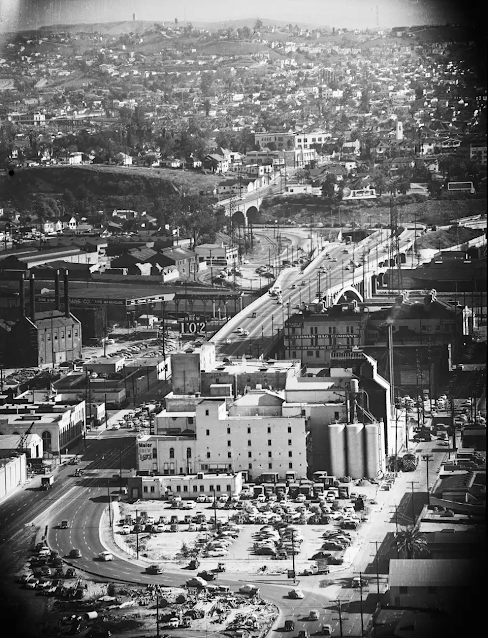
1946, Facing west on Aliso St Bridge at Los Angeles River. By 1955, Pacific Electric tracks were removed and the bridge was widened and converted to Santa Ana Fwy (US-101).
LA City Hall in background; gasometers, containing natural gas, at left BPR photo.
Bambaata Bryant those were natural gas storage tanks. Those particular tanks in the photo were around until the early 70s. There was another like the tallest one in that photo that was located on the South- Central/ Westside of Los Angeles. That Tank was actually on W. 60th and Western Avenue. They were dismantled in the 70s because the Tank that was located on W.60th and Western caught fire. Folks evacuated because of fear of an explosion that could have wiped out a portion of South-Central Los Angeles. Fortunately, the fire was extinguished. After the incident, All those tanks were torn down, never to be seen again. The only remnant of those storage tanks, if it's still there, is a small one that's located off of I-405 in the Long Beach/ Signal Hill area.
Bambaata Bryantthey also had those types of storage tanks in the San Francisco Bay Area also. Used to be a tall one in Oakland near Oakland Airport and a Tall one in San Francisco. After the fire in Los Angeles, those in the Bay Area were also dismantled for safety reasons.
1928, In 1928, the construction of Richfield Tower, also known as the Richfield Oil Company Building, began in downtown Los Angeles. Designed by architect Stiles Clements, the building quickly became one of the city's most notable architectural landmarks. At the time of its completion in 1929, the tower was a striking example of the Art Deco style, featuring a sleek, modern design that stood in stark contrast to the more traditional structures of Los Angeles. The 13-story office tower served as the headquarters for the Richfield Oil Company, one of the largest and most influential oil companies in California at the time. With its distinctive, stepped silhouette and bold, geometric lines, Richfield Tower embodied the ambitious spirit of Los Angeles during the late 1920s, a period when the city was transitioning into a burgeoning center for business and industry. Thank you to Club Tepatlaxco Futbol. Posted Wednesday, January 1, 2025.
1937, View of Richfield Building from a short distance away. It was razed in 1969 to make way for the Arco Plaza at 505 S. Flower Street. Thank you to LAPL.
Close-up of the iconic Richfield Tower. Thanks to Hunter Kerhart for these close-ups of the Richfield Tower. Martin Turnbull offers some beautiful pics of the building too. Check them out.
So it looks like the front of the building opens onto 6th Street and to the left is Flower. But it has a Flower Street address. Hmm.
Located at 555 South Flower Street between Figueroa and Flower, north of 6th Street.
Features a black and gold Art Deco façade. The unusual color scheme was meant to symbolize the "black gold" that was Richfield's business."
This comment on its architecture was interesting,
The building was covered with architectural terra cotta manufactured by Gladding, McBean, as was typical of many west coast buildings from this era. In an unusual move, all four sides were covered since they were all visible in the downtown location.
The 12-floor building was 372 feet (113m) tall, including a 130-foot (40m) tower atop the building, emblazoned vertically with the name "Richfield". Lighting on the tower was made to simulate an oilwell gusher and the motif was reused at some Richfield service stations.
Martin Turnbull has some terrific photos of the tower's exterior and interior, including the lobby elevators and ceiling. It is, er, was beautiful.
Well, I don't see a Texaco star in this shot, so it's not a Texaco station, but it was a gasoline station in 1924. You might be able to get a larger view of the scene from Facebook.
Okay, in this second shot, the gas station [seen at the bottom left] does have a Texaco star sign right at the corner. 1954. Kind of neat. This was Donovan's station. I don't know how long he owned the station, but Dad stopped for gas here regularly. It was close to his ride home, the Pasadena Freeway, and his work down at 1st & Hill.
Dad was a fan of Red Barber, born in Columbus, Mississippi, and studied at Florida State. Dad was a wordsmith, constantly toying with word combinations and tried and true phrases from another era.
"Walkin' in the tall cotton"– also used to describe success.
"Slicker than boiled okra"– describing a ball that a fielder was unable to get a grip on.
"Easy as a bank of fog"– describing the graceful movement of a fielder.
"Tighter than a new pair of shoes on a rainy day"– describing a closely contested game.
"Tied up in a croker sack"– describing a one-sided game where the outcome was all but decided.
To further his image as a Southern gentleman, Barber would often identify players as "Mister", "big fella", or "old" (regardless of the player's age):
"Now, Mister Reiser steps to the plate, batting at .344."
"Big fella Hatten pitches, it's in there for strike one."
"Old number 13, Ralph Branca, coming in to pitch."
A number of play-by-play announcers including Chris Berman have adopted his use of "back, back, back" to describe a long fly ball with potential to be a home run. Those other announcers are describing the flight of the ball[citation needed] but Barber was describing the outfielder in this famous call from Game 6 of the 1947 World Series. Joe DiMaggio was the batter:
"Here's the pitch, swung on, belted ... it's a long one ... back goes Gionfriddo, back, back, back, back, back, back ... heeee makes a one-handed catch against the bullpen! Oh, Doctor!"
The phrase "Oh, Doctor" was also picked up by some later sportscasters, most notably Jerry Coleman, who was a New York Yankee infielder during the 1940s and 1950s and later worked alongside Barber in the Yankees' radio and TV booths.
In Game 4 of that same 1947 Series, Barber memorably described Cookie Lavagetto's ninth-inning hit to break up Bill Bevens' no-hitter and win the game at once:
"Wait a minute ... Stanky is being called back from the plate and Lavagetto goes up to hit ... Gionfriddo walks off second ... Miksis off first ... They're both ready to go on anything ... Two men out, last of the ninth ... the pitch ... swung on, there's a drive hit out toward the right field corner. Henrich is going back. He can't get it! It's off the wall for a base hit! Here comes the tying run, and here comes the winning run! ... Friends, they're killin' Lavagetto... his own teammates... they're beatin' him to pieces and it's taking a police escort to get Lavagetto away from the Dodgers! ... Well, I'll be a suck-egg mule!"
Here is a May 20, 1950 ballgame with the Dodgers against the Pirates at Ebbett's Field.
Brooklyn Dodgers vs. Pittsburgh Pirates, May 20, 1950.
Spent a few hours at Hollywood & Vine. Once with my friend, Carmela Denton, and her family for a Sunday morning brunch in a restaurant on the top floor of a bank building with a wonderful view of Hollywood. It was the first time I'd ever had blintzes. The other time was when Chuck scheduled an audition for us and Dad on the show, Family Feud, hosted by Richard Dawson, 1976-1985, and again in 1994-1995. After the audition, we went for dinner and drinks at a nearby restaurant and talked about the fun we had.
Chuck Pullman's gravestone is missing. He's buried underneath his mom, or perhaps on top.
Josephine was born in Denver County, Denver Colorado on November 13, 1915, one year after Dad, according to Find A Grave. I'd always thought her birthday was November 30th. Wow. And she passed on the 26th of July, 1953, two years after her mother passed, at the tender age of 37.
Sally, through Find A Grave, was able to find a record of Ma's burial. Born in Wisconsin on January 19, 1879, and she passed on February 17, 1951 at 72 years old.
This is the crypt that Conroy is buried in, and I believe his wife, Geraldine, is also laid to rest here. It's the one on top. Only name given is William Michael Conroy, and you can see his dates.