

Santa Anita, 1935.

1939, ^ - View of the Santa Anita
Racetrack paddock (foreground) and a packed parking lot (background). Large
crowds of people can be seen walking across the pathways surrounding the
paddock, as well as sitting on benches along the main entrance. The paddock
area is where horses are 'assembled', saddled, and mounted before a race.

1934, ^#^^ – View of a filled-to-capacity parking lot on Opening Day at Santa Anita Racetrack, December 25,
1934.

2006, *^ - View showing the Art Deco entrance to Santa Anita's
grandstands. Photo by Ellen Levy Finch.


During one of our summer pilgrimages to Bass Lake, California, suffice it to say that Chuck's athletic ability afforded him a rescue of a family member. As an aside, Bass Lake forms one of the earliest memories of my life. I was five and was walking along a paved and winding utility road of a campground with my left hand clutched in my Dad's right hand.
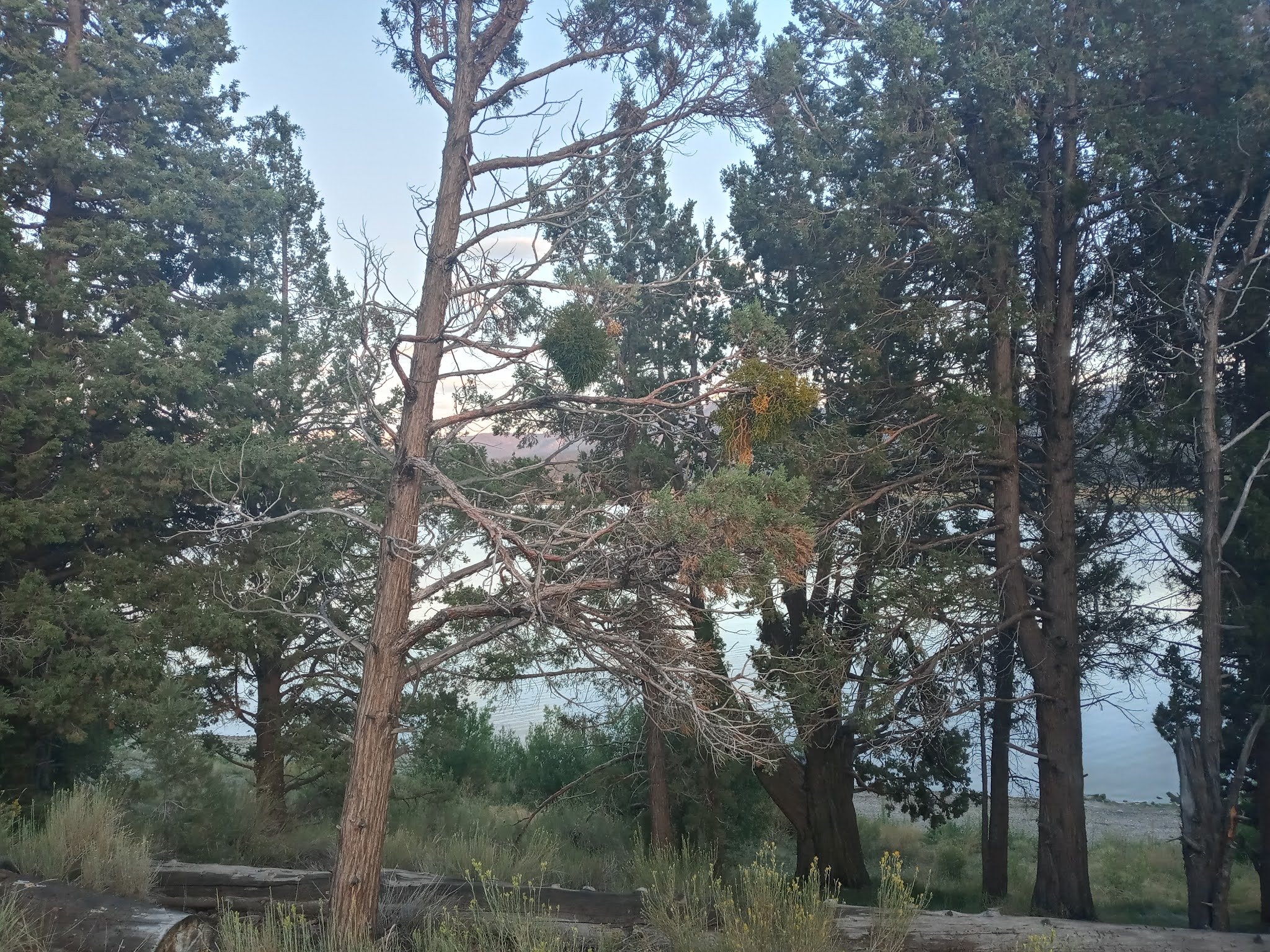
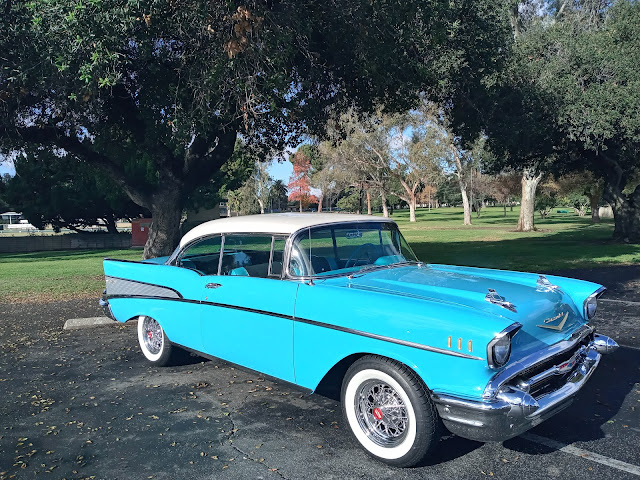
Pictured below was the campsite we claimed in 1962. Funny to see nobody in this picture except for our gear and Dad's station wagon. Black and white and stark. No color from the Coleman stove. No color from the towels and clothing drying on the line. The trees are colorless. And still I treasure these images because these were the tools of pioneers. No one can tell the baby blue colors of the the Ford Station Wagon. 
On Saturday, July 11, 2026, Tom wrote,
I remembered, "Bass Lake." I had the best time ever at any camp spot we ever went to because the people there that had a good size boat who would take most of us one time around the whole lake which had many hidden fishing holes that just seemed like out of a Tarzan movie. I remember we were having lunch at the picnic table that the park provided and a big gopher snake crawled right under the table, like he'd done it a million times, and nobody bothered it. It must of been over 5 feet long. Chuck had the most fun because he knew how to do all the fishing. It was the greatest, Bass Lake.


I stopped inside Immaculate Conception in Monrovia
yesterday. Hadn't been here in 3 1/2 years. I want to cry every
time I step foot in here. So many memories, like biding my time as a
kid, playing in and around the pews and on the cool marbled floor while Mom
prayed the Stations of the Cross. And Dad taking confession here and
praying for his mom, dad, and Josephine after lighting a votive candle and
kneeling in front of the image of the Sacred Heart. The mysteries of life made
everything so meaningful, so powerful, and beautiful. Dad would pray the
Rosary on the short drive from Duarte to Ralph's Grocery on Live Oak Avenue in Arcadia. Sally, with the help of her brother, Tom, coronated the statue of the Virgin Mary in an elegant, spartan pageantry. Charlen & John
declared their vows here. We were all part of a family then. The love and
beauty lost from those days is often too much. https://duarterock.wordpress.com/2018/02/25/immaculate-conception-monrovia/
Located at 500 W Temple St, Los Angeles, CA 90012, between Grand Avenue and Hill Street. I believe that Charlen worked here and Dan.


Mozart's dates are 1756 to 1791: he was only 35. Britannica explains:
Wolfgang Amadeus Mozart, in full Johann Chrysostom Wolfgang Amadeus Mozart, baptized as Johannes Chrysostomus Wolfgangus Theophilus Mozart, (born January 27, 1756, Salzburg, archbishopric of Salzburg [Austria]—died December 5, 1791, Vienna), Austrian composer, widely recognized as one of the greatest composers in the history of Western music. With Haydn and Beethoven, he brought to its height the achievement of the Viennese Classical school. Unlike any other composer in musical history, he wrote in all the musical genres of his day and excelled in every one. His taste, his command of form and his range of expression have made him seem the most universal of all composers; yet, it may also be said that his music was written to accommodate the specific tastes of particular audiences.
His middle name is interesting. One of the students I worked with was a 9th grader by the name of Crisostomo. Crisostomo didn't talk much in class and didn't socialize much, but he was loved. The students in his class used to refer to him as Ninja because he would come into class stealthily and sit at his desk without hardly a word. Then today, eleven years later, I come to learn that his name is ancient Greek for "golden-mouthed." Briefly, on one day we were reading Act I, Scene I of Romeo & Juliet in groups of four. Crisostomo was in my group along with two other girl classmates of his. I was a little anxious because Crisostomo hadn't spoken almost at all in class. I started the reading aloud in the group. Then the girl to my left read, then the girl to her left read, and then Crisostomo. And he began reading, his beautiful tone lifted the importance of the passage above anyone of ours' expectations. The two girls quickly raised their heads from the text and fixed their eyes wide-eyed on me as Crisostomo, devouring the text, pressed on with the reading. My heart swelled. Not just for his personal accomplishment but that his eloquent reading made the exercise remarkably beautiful. Okay, enough.
Lacrimosa is one segment in the 8 sections of Mozart's Requiem, a mass for the dead. The Lacrimosa is the final segment of the section titled, Sequentia.
from Wikipedia:
The Lacrimosa (Latin for "weeping/tearful"), also, a name that derives from Our Lady of Sorrows, a title given to The Virgin Mary, is part of the Dies Irae sequence in the Roman Catholic Requiem Mass. Its text comes from the Latin 18th and 19th stanzas of the sequence. Many composers, including Mozart, Berlioz, and Verdi have set the text as a discrete movement of the Requiem.
The lyrics are in Latin.
Lacrimosa dies illa
Qua resurget ex favilla
Judicandus homo reus.
Huic ergo parce, Deus:
Pie Jesu Domine,
Dona eis requiem. Amen.
Their English translation is here:
Full of tears will be that day
When from the ashes shall arise
The guilty man to be judged;
Therefore spare him, O God,
Merciful Lord Jesus,
Grant them eternal rest. Amen.