Saturday, March 16, 2019

ABSOLUTE BEAUTY: SOUTHERN CALIFORNIA OIL REFINERIES

One of the structures that I absolutely love is oil refineries mainly for their complexity and size. They are beautiful. I remember that when I worked for Vons.com in Torrance in 2015 that I used to drive down 190th Avenue and Hawthorne back to the Vons store and past the Torrance Refinery.


The refinery pictured below is a shot I took in 2016 of the Plains All American Pipeline, located at 690 N. Studebaker Rd, Long Beach, CA 90803.  The company has locations all across the country, even a few in Colorado.  I didn't realize that there were so many refineries in the Southland.  Very interesting.  


Then there was the very interesting Wilmington refineries.  


Will never forget the Stevedores strike in Long Beach back in 2015.

Sunday, March 10, 2019

SANTA ANITA RACE TRACK

My first memory of attending Santa Anita Race Track in Arcadia, CA was with my dad, Chuck Pullman, and possibly Bill Conroy.  I was 6 years old.  We were sitting in one of the green booths of the grandstand when Dad asked me what horse I wanted to bet to win.  I liked the number 5 back then.  I still do, so I told him #5.  He bet on it, and the horse placed in the money.  Not bad for a rookie para-mutual bet, eh?  The jockey had a shimmery, silk green jersey with the number 5 in white.  The excitement, the smells--cigars, earth, beer, hotdogs--the sights--the expansive arena framed by the foothills and the exclusivity of the Club House all engulfed me.  The colors and contrasts were stunning, not to mention the roaring crescendo at the leading chargers drove down the stretch to the finish.  It was exciting.  But beyond excitement, the old-fashioned grandeur of the place, the track could also be a place where you didn't have to think while being a part of history: Bill Shoemaker, Laffit Pincay, Jr., War Admiral, Seabiscuit, winos, gamblers, winners, and losers.  It was a heady mix.  It was a great place to observe society's strata--the well-dressed loser, the modest-attired winner, and a few young men dressed as dandies.  Most in the pavilion wore polo shirts and sunglasses.  A few men puffed on fat cigars.

My dad was no gambler.  But he could be a betting man looking for some prayerful advantage.  His sister's birthday was November 30 (11/30/One of the scenes I love this time of year is the view of the San Gabriel Mountains, Mt. Wilson, and other peaks, from the grandstand at Santa Anita Race Track in Arcadia.  

So far, I am relieved and feel content at having dodged what would amount to a devastating demolition of an era and culture that once gone will be lost forever.  I do feel lucky that the owners have yet to surrender their property to townhome developers.  So many wonderful memories at this park.  There was the one time that I'd rushed to the track to place a bet for a friend who had a hunch or a tip.  It had been raining heavily earlier in the week and the track was soggy.  It was a thrill to buy and read The Racing Form, and still, it was not easy picking a winner.  Reading the 
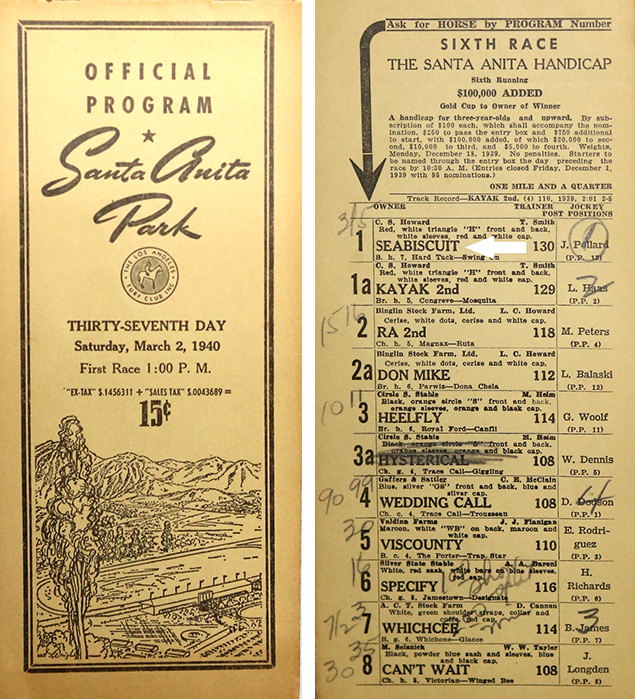
And the Santa Anita Racing Program.  The cultural and literacy of the track was beautiful.  Numbers, names, weights, odds, dollars.  Just gorgeous.


The art, the setting, and the history of the track was storied and beautiful.  Numbers, names, weights, odds, dollars, and the aura of men down on their luck hoping for that big exacta ticket.  I was such a man, a young man.  I was at the track with my brother, Joe.  We were on the infield, combing over the program, looking for meaning in numbers and names and odds.  I asked Joe if I could borrow $10 for an Exacta pick.  I promised to share half of the winnings if I'd won.  He agreed.  And the two horses came in, totaling $365.  Oh, yeah!  

Even the printed materials, especially the printed materials were what built its following.  Fans flocked to Racing Form and Program.  Who wouldn't?  Will never forget how lonely some men appeared, sitting by themselves nursing the wounds from the previous race while trying to find some winning formula for the next in a kind of restitution.  And maybe, just maybe that's exactly how they wanted things.  To be alone, putting their money on chance in a big, beautiful arena with indoor grandeur and Southern California's outdoor magnificence.

Monday, March 4, 2019

The Ghost & Mrs. Muir, 1968-1970

I loved this show growing up, mostly because of Hope Lange, who reminded me, of course, of Petula Clark, whom I adored.  And given the fact that the show only ran for two years, 1968-1970, it must have gotten panned by the critics.  But looking back on it now, or rather watching an episode of it today, I thought that the dialogue was sharp and taut.  Extended metaphors were terrific.  Lots of literary allusions.  It was wonderful.  From a literary or aesthetic standpoint, it was quite good.  You're not going to find anything this thoughtful today. Little did I know then that the TV series was based on a 1947 movie of the same title, starring Gene Tierney, Rex Harrison, and George Sanders.  George Sanders was one of my favorite seasoned actors growing up.  

Friday, March 1, 2019

1980s Music: Anthem to a Young Man's Life

Perhaps the greatest musical period of my life was back in the early 1980s when I was working for United Parcel Service and going out to Mod Clubs and concerts with neighborhood friends.  I used to go to The Crush Bar on Cahuenga Blvd. in Hollywood and to the Sunset Club, you got it, on Sunset Blvd., a tiny place that used to play early 60's mod tunes, pieces like the Monkees', "I'm a Believer," 1966.  I did go to the Odyssey one year and had a bizarre experience.  I asked a young woman to dance, and her girlfriend came up to her, grabbed her hand, and walked off with her.  Okay, I was not in Kansas anymore.  

Lots of great music.  One song I used to hear on the radio a lot back then was XTC's "Making Plans for Nigel."


The other band that I just loved was Big Country and their hit song "In a Big Country," released in May of 1983, just one month after I started driving for UPS in Beverly Hills.  


I was telling a friend of mine how the Madness video of "One Step Beyond," released in October of 1979, is one of the most iconic of all Mod songs.  I loved "Mexican Radio."


I loved Wall of Voodoo's "Mexican Radio," released in 1982.  It would come on the radio late at night while driving into Baldwin Park from Duarte to work nightshift at UPS. 


And who could forget Oingo Boingo's "Dead Man's Party," released 1985.  John Simpson and I hosted a party at the Baldwin property, 2006 Baldwin Avenue in Arcadia. Will never forget Vons trucks rambling in the middle of the night up to the stores in Arcadia and Monrovia.  They never failed to wake me up at 3am.  Someone at the party played this song, and all in attendance were up dancing on the living room floor.  It was fun.  Loved that song and those times.  They were, to quote a friend, "Off the hook."  


And it was Roy Parker who turned me onto the English Beat and their song, "Mirror in the Bathroom," released in 1980, and other classics, like a reprisal of Smokey Robinson's "Tears of a Clown."  

And "Save It for Later," released in 1982.  I'd seen the English Beat at Perkins Palace in Pasadena and at the Palladium in Hollywood with Mike, Kevin, and Kathy.   

I saw the Ramones at Perkins Palace from the mosh pit. 

And though everyone had heard The Pretenders' "Back on the Chain Gang," 1984, a thousand times, perhaps one of their favorites is "I'll Stand By You," 1994.  


Perhaps the most memorable and loved song from that period was The Cure's "Just Like Heaven," 1987.  I know I loved it then and I love it now, perhaps even more so now.  For more, see here.

Sunday, February 24, 2019

MOM, 1938

This framed picture sits atop my desk at my San Gabriel apartment.  My printer is there to the left.  But the first time that I'd ever seen this photo of Mom was at her mother's apartment on Detroit Street in Denver way back in 1969.  Grammie used to live in a basement apartment at 1620 Detroit Street.  

Will never forget our last visit to see Grammie in 1967 or 1971 on Detroit Street in Denver.  We entered the building, no security in those days, stepped down one floor to the basement, turned the corner and made our way to the boiler, the machinery matrix of pipes that wrapped around a tank yet heated the entire building quite effectively.  

Standing between her door and the boiler, Dad knocked on her door.  He knocked, she answered, and we stepped into her space, her one-room flat.  I immediately was absorbed by such a place.  Pa's apartment in Temple City was on the second floor, airy, sunny, comfortable.  Grammie's subterranean unit had windows high on the wall that looked out onto the sidewalk where you had to raise up on your tiptoes just to look out onto the street.  Treetops and the heavens were out of view.   Fascinating but also degrading and pitiful.  Reminds me of how Mom was mesmerized by the view from her front window of the sunlight shining on the San Gabriel Foothills in Duarte.  Something about Denver made her life in Duarte feel like she was living in paradise.  

I tried to make sense of her sofa, a table, and furnishings as Dad and Grammie stepped into her kitchen and out of our view.  I scanned her place.  The windows were at the top of the wall in her basement studio.  She had a kitchen, a living room, and one bedroom.  Her means were survival level.  Growing up under parents who survived the 1930's Depression and its survival mindset, the war, and the war chest that came with it meant that you were sentenced to a spartan existence.  

We were always on Depression era measurements of wealth and well-being.  Back in the 1960s, our Aunt Helen would visit occasionally but always stepped into our Duarte home with a single loaf of bread tucked in the crook of her arm.  A loaf of bread.  The gesture was symbolic of abundance, sharing, and that your host might never know hunger.  During the Depression, food often meant "May your table always be full."  And will never forget the last year that Grammie visited us in Duarte.  All the adults were out of the house except for Grammie.  It was lunch, the sunlight beautifully warming us.  Grammie reached for an item from the refrigerator that she thought would satisfy us: Farmer John's "Eastern" pork sausage.  That'd do the trick.  So she spent a few minutes turning the sausage in the skillet and served it to us.  She ordered us to "sit down," which we did.  And she served us.  The white Corelle plates held three burnt sausage links.  I studied it a second or two before realizing, "Wow, we really are poor."  Grammie may have considered meat of any kind a symbol of wealth.  One man's treasure is another man's . . . 

Returning to Grammie's man cave, I saw a few framed photos on a corner console, nothing high-Victorian or that fancy; probably closer to this William & Mary table.  
From the center of the room near her sofa, I could see the framed pictures in the distance but not the subjects.  So I stepped closer, slowly to the pics and I began to make out the eyes and the smile of some one very familiar and realized that one photo was of my mother as a young woman.  [See that photo above.]  I'd never seen pictures of my mother as a young woman, but only as mother to me and my siblings.  I could not believe how beautiful she was.  I was never more proud of her.  I loved the photo so much.

Will never forget a few details of Grammie's studio apartment.  I remember her Bakelite 500 rotary phone [still cheaper than an iPhone] on the stand next to her sofa.  I picked the phone up off the receiver and examined the 1940s phone.  I started toward the kitchen area, but then Dad and Grammie were making their way back out to the front room and so I gave up that excursion.

The framed picture below of Mom is dated 1938.  


Sunday, December 30, 2018

"CELLAR-DOOR CAGNEY"

Cagney believed in hard work, later stating, "It was good for me. I feel sorry for the kid who has too cushy a time of it. Suddenly he has to come face-to-face with the realities of life without any mama or papa to do his thinking for him."
In the last week, I found myself watching a few James Cagney (1899-1986) movies, starting with White Heat (1949), the movie with the famous ending of "Look, Ma!  I'm on top o' the world!" before Cagney's character, Cody Jarrett,  is blown to smithereens.

Cagney was a favorite in our house since our parents grew up in his days.  

I learned only this morning that prizefighter great, Floyd Patterson and Russian ballet dancer, Mikhail Baryshnikov, were pallbearers at his funeral.  

Then there's the 1950 Kiss Tomorrow Goodbye, another terrific film starring Barbara Payton and Ward Bond  


His 1943 movie, Johnny Come Lately had some interesting scenes and dialogue, but the plot was predictable and lacked novelty.  


Besides Angels with Dirty Faces and White Heat, Yankee Doodle Dandy (1942) is probably Cagney's most memorable film, particularly the scene where he dances down the staircase.  It's the only film for which he won an Academy Award.  


As Cagney's character, Cohan, reached the foot o the stairs and makes his way to the door, a butler, played by Clinton Rosemond, presents his coat to him before he exits.  I initially thought that the two butlers were the Nicholas Brothers, but they were too popular, too in-demand, for this film.  Writers and editors at Wikipedia must be social justice warriors, for they prefer to lament that 
Rosemond was frequently relegated to playing demeaning parts, such as a stereotypical "scared Negro." 
I don't know.  Does Rosemond look scared or unhappy or less than in this scene with a money-making star, like James Cagney?  No.  Besides, Wikipedia states that "Rosemond was frequently relegated," meaning that he had work and lots of it.  Meaning he was making money as an actor.  Most actors would love such roles.  Wikipedia's editors are pathetic SJWs.

And of course, there is this classic dance scene from the 1955, The Seven Little Foys, co-starring Bob Hope.  

Cagney's skills are chosen for a cameo in this compilation on dancing put to the music by The Killers' song, "All These Things That I've Done," (2004).

Tuesday, December 11, 2018

MOM LOVED CHRISTMAS

My mom absolutely loved Christmas.
She loved the decoration.  In later years, when most of us were out of the house, she would ask Joe to pick her up a Christmas tree.  She would share with me memories of her and her brother gathering up their skates and walking to a nearby frozen lake.  I can imagine Mom skating at scenes like this one, though this particular photo is from Evergreen, CO, which is up at the foot of the Rockies.


And though Mom absolutely loved Southern California's brilliant sun compared to the sun in Denver, she also loved active, outdoor scenes too. 

Mom loved to decorate her living room and dining room with Christmas ornaments. 


Kathleen Larkin mailed her a Christmas wreath, which she hung out on her front door every year. 
Mom and Dad both would hang Christmas cards on a string across the ceiling, place a few on the furniture in the living room as well as on the hutch in the dining room. 

And perhaps her most treasured display was the Nativity set. 


As for Christmas music, Mom's favorite was Bing Crosby, 
 
But she liked all of it.  What I posted about Dad preparing Thanksgiving and the Christmas song list there, she too enjoyed those.  And why not?  So much of christmas music is like a tender lullaby as my dear friend, Joanne put it listening to the Irish band, Capercaillie.  Here's that list from the post about Dad listening to the radio while prepping the turkey late into the night on Thanksgiving Eve. 
I do miss the Thanksgiving dinners that my dad used to prepare. He'd start the night before.  He'd set his radio to KFI where they'd already begun playing his Christmas favorites--Bing Crosby's "It's Beginning to Look a Lot Like Christmas," 1951, "Mele Kalikimaka," 1950, Perry Como's "Jingle Bells," 1946, Burl Ives' "Rudolph the Red-Nosed Reindeer," 1964, and choral pieces by Mitch Miller and His Gang.  I'll never forget his "Sing Along with Mitch" Christmas chorus album we had in the house.  I liked Mitch Miller, 1911-2010, for the invigorating energy he sang Christmas songs with the delicious irony that he was Jewish.  Funny to see how some of my musical influences stem from the '40s, '50s, and '60s. 
One of my favorite soprano singers is Renee Fleming.  I could not believe what I was hearing when I first heard her voice so many years ago, probably around 2005 or 2007.  The screensaver on my computer was a photo of her in a red Christmas dress.

When a woman's voice can make you cry, you know that she has struck a chord of beauty and love.  And few voices have that power.  Hers does.  I know for a fact that Dad would have loved to hear her voice.  Dad's favorite singer was Anne Murray, but the beauty here in Fleming's voice is inimitable.  The beauty of religion and religious stories is that they tend to be mysterious, the more improbable the more we try to make sense of them.  But they are told in an aura of mysticism, wonder, and love.  And when we hear these carols and familiar stories so many years later, we are transported back to that improbable love, where we honor the source of life and love found in the Biblical story of Christ's birth, a love in which few are capable in a world that seems to know mostly evil, envy, and violence.  And so Christmas and its celebrations are that one time during the year that Christians around the world commemorate peace which turns our hard, stupid hearts toward gratitude and love.
Last year, on Christmas Eve, I posted this video from Westminster Abbey in London.  


Along with "Silent Night" in German, or "Stille Nacht."  


And then for Christmas delicacies, her favorite without comparison was See's Candies.