Monday, October 17, 2016

Dad's Memorial Card, 1988

Dad's memorial card from Zook Mortuary.  

It's hard for me to look at this and see Kansas City, Missouri.  I get that that is where Dad was born, but that certainly is not his resting place.  I am not even sure that Dad is resting anywhere for that matter. No, he's in LA somewhere, somewhere downtown or near there, probably dropping in for an early morning mass or a late afternoon confession before going across the street to Olvera Street to grab a cheese enchilada, rice, and beans and a Coors.  

I really don't like this famous image of Christ.  When we were kids we were taught to revere, even worship Christ in all of his man-made forms.  Whether it was the suffering Christ on the cross in St. Joseph's chapel at Santa Teresita in Monrovia or a more artistic rendition of the crucifix at St. Frances [one of the Franciscan ordersof Rome Parish in Azusa. But it was this particular memorial card that disturbed me as a kid because the image is one of the sacrificial Christ, a sacrifice called for by his father. Never commenting on the art or the story behind the image, my dad exalted in his own heart the holiness of Christ's suffering.  

Speaking of the Old Mission, called La Placita, I could not help but post a few pics of it.  For it was a great place of comfort for my dad.  He came here first after stepping off a train from San Diego while on leave from the war.  He'd walk over to La Placita, find a quiet pew, kneel, and pray for those he loved and the ones he missed.  The prospects of seeing his mom and dad, his wife and baby girl lifted him.  The church consoled him.  Refreshed, he stepped out of La Placita and into the sunlight.  His prospects carried him across the street to Olvera Street where he got some Mexican food.  The War was over.  He could now begin to rebuild.  

Twenty years and 7 kids later, he returned to San Diego for weekend excursions, staying in the Padre Trail Inn where he returned to his poetry of composing striking post-card greetings in his signature all capital letters and commit to hours of interest devouring the craft of local writers from the San Diego Tribune.  He settled in.  A ribbon of smoke from his Tareyton, perched at the edge of a motel dresser, rose to the ceiling and the room absorbed it.  To fuel his chariot further, Dad nursed a beverage for inspiration. 

The image of the Tareytons made me think of Dad's coconut ashtray he'd brought back from the war. It had some names and dates scrolled on it in  yellow paint, but I was too young to register the names to memory before Mom tossed it. I am sure it had Majuro Island written on it somewhere.  I liked the ashtray because the fibers or hairs of the coconut were still on it, making it look like a fresh extraction from an island in the Pacific from a war only 20 years since its close.  It was a brilliant trophy to survival and how men made useful things from bad situations.  All was not lost. Oblivion and death do not hold sway over men's lives.  

The pack of cigarettes there at the right are 100's. Before he quit cold turkey, Dad almost always smoked Tareyton regulars and only rarely did he buy 100's when a liquor store was out of regulars. But I like the image of the worked pack, and that's why I posted it. 


He'd explore Presidio Park with his children and schedule a stop to the San Diego Zoo.  

And as the day came to a close, he'd take us out to dinner in Old Town San Diego at La Pinata with its colorful wicker seats and pinatas hanging from the ceiling. 

To digress even further, my last visit to San Diego with my dad came in 1982.  It was me, my dad, and Sally.  I drove my green, 1980 VW bug.  We stayed at many hotels over the years.  This time we stayed at Mission Valley Inn.  

And as Dad settled in to read the local journalists and write his memorable postcards, Sally and I drove down to the Old Town State Park bypassing our old, childhood haunts, Presidio Park, where we found a weekend festival with booths lining the periphery of the park. The city-given name of the park is Plaza de Las Armas.


And why wouldn't there be a festival?  It was after all Cinco de Mayo weekend, 1982.  We were there actually on May 1, a Saturday, and Cinco de Mayo fell on the following Wednesday. So that weekend there were lots of vendors that occupied the park. Wandering through the park and observing things and people, sliding through the hordes we found a vendor selling dollar-sized corn tortillas for $.25.  They served them fresh from the grill on a sheet of baking paper.  The tortillas were topped with butter and salsa. Uncomplicated. They were warm, salty, and divine. So we ordered more.

Afterward, we drove downtown looking for a movie theater.  The Walgenbachs were always the ones for the movies.  It was a tradition.  It was love. It was history.  It was a way to share the times of our parents, who loved the movies and legends of Hollywood. We found a film.  Blade Runner, starring Harrison Ford, aka, Hans Solo.  We didn't plan to see this movie, so when we arrived the line was wrapped around the block.  We got in line anyway.  We stood.  We waited. We sat.  On the sidewalk.  The official release date for Blade Runner wasn't until June 25, 1982. But we were in San Diego on May 1st.  So how did we see a movie prior to its official release? San Diego happened to have an early, special preview.  

San Diego Sneak Preview shown only once in May 1982.[4] This version is nearly identical to the 1982 US theatrical version, except that it included three additional scenes not shown before or since, including the Final Cut version (2007).

Call it luck.  The movie was long for me.  The visuals were stunning but haunted by a predacious search for replicants, beauties that needed to be eliminated.  The movie seemed to be a hard-boiled, noirish commentary on post-deconstruction, whatever that means.  Where has the time gone? Where are the people and actors of the era that anchored my identity and mojo? Where is Sean Young, Harrison Ford, Rutger Hauer, and character actor M. Emmet Walsh, Daryl Hannah, James Hong, Brion James, Edward James Olmos, aka, "Jaime Escalante," and others?  I don't like the detachment or dispossession from life of those days.  I was still working nights at UPS in Baldwin Park and trying to make a go at selling Amway.  Mom was a good soul and a good sport in those days to buy a large tub of Amway's soap at wholesale from me. She actually liked the soap and said so, which worked to silence the criticism and suspicions from my siblings.  It was Bill and Darlene Hardister who were my Amway mentors.  Bill said he had given up his lucrative $70,000/year trucking job to sell Amway.  I loved Darlene.  She had an older daughter, quite attractive, from a previous marriage.  Wish I could remember her name.  The picture of Darlene below is one that in my mind captures her funny laugh, her energy, and joy.  She may not like the picture, but for me, it captures how much she loved to laugh and thought how so many things that people did in life were funny.  Life and people absolutely delighted her.  


Darlene Hardister.  Not sure of the year.  2005 maybe.

But to return to La Placita Plaza in downtown Los Angeles.  It is a beautiful, old little Spanish chapel. I love it.  I loved it because he loved it.  

For some excellent older shots of this little chapel and perhaps a glimpse of the world my dad inhabited, see these pics.

Even in the mornings before he'd go into work, he'd stop here for a 5:30 or 6am mass. He'd get on the Pasadena Freeway from the 210 and wind his way toward downtown. But instead of going directly to the courthouse, he'd stop here and pray for his Pa, Ma, and sister, Josephine.  Before ballgames, he'd stop here and run across the street for a Mexican dinner for he and his three youngest sons, and a beer for himself and sodas for the boys.

The interior was tiny but beautiful.  It was all aged gold.  I do remember thinking where do I fix my devotion since there was no large crucifix on the wall behind the altar as they have at Immaculate Conception or St. Joseph's Chapel at Santa Teresita Hospital in Monrovia.  Instead, this tiny La Placita chapel had only gilded framed paintings. Okay.  The chapel evoked a storied worship. But knowing how much comfort this place gave my dad means that this place still occupies a very dear corner of my heart. 


Friday, October 14, 2016

Elk in Estes Park, October 13, 2016


Mom and Dad on a rock in a river at Estes Park, Colorado, probably, 1939 or 1940.  Amazing to think how these 2 individuals made everybody in the family more lovable.  
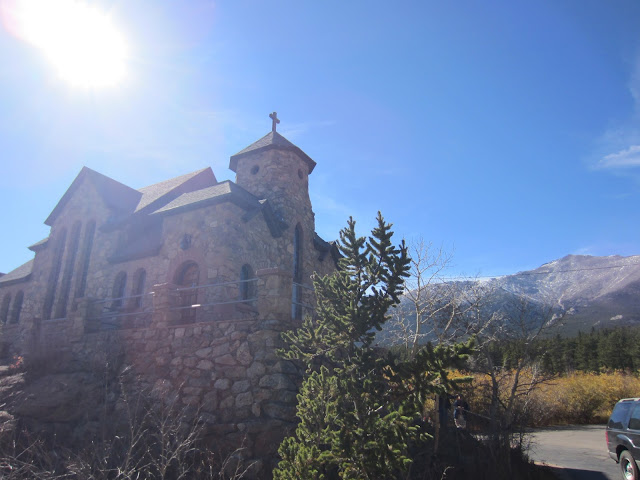
We also stopped at Camp St. Malo.


The following shots are west of downtown Estes Park, CO


Old Church Shops, Estes Park, CO

Tuesday, October 11, 2016

Dad Loved Radio

My dad loved radio.  I can imagine him sitting at home or walking by a Woolworth's or pharmacy and hearing voices broadcasting Notre Dame and Frank Leahy as they rolled on to victory.


Maybe it was his love for the glory of the old days of Knute Rockne commandeering the Irish to a win against the dominant Army Black Knights team in 1924. 
After the game, New York Herald Tribune sportswriter Grantland Rice, 1880-1954, penned one of the most famous ledes in sports history.  Rice's iconic memorable headline appeared in the paper's evening edition, as well as the Sunday, October 19 printing.  The Four Horsemen helped lead Notre Dame to a its first-ever national championship, and the quartet of backs became college football icons.
Well, that is pretty cool.  By the way, Rice's NY Herald piece opened with this:
Outlined against a blue-gray October sky, the Four Horsemen rode again.  In dramatic lore they are known as Famine, Pestilence, Destruction and Death.  These are only aliases.  Their real names are Stuhldreher, Miller, Crowley and Layden.  They formed the crest of the South Bend cyclone before which another fighting Army football team was swept over the precipice at the Polo Grounds yesterday afternoon as 55,000 spectators peered down on the bewildering panorama spread on the green plain below.
Wikipedia has the background on the Irish's Four Horsemen
George Strickler, then Rockne's student publicity aide and later sports editor of the Chicago Tribune, made sure the name stuck. He had pitched the idea out loud at the halftime of the Army game in the press box as a tie in to the 1921 Rudolph Valentino movie The Four Horsemen of the Apocalypse.[5] After the team arrived back in South Bend, he posed the four players, dressed in their uniforms, on the backs of four horses from a livery stable in town. The wire services picked up the now-famous photo, and the legendary status of the Four Horsemen was assured.[5]
After that win over Army, Notre Dame's third straight victory of the young season, the Irish were rarely threatened the rest of the year. A 27–10 win over Stanford in the1925 Rose Bowl gave Rockne and Notre Dame the national championship and a 10–0 record.
As it usually is with legends, the Four Horsemen earned their spot in gridiron history. Although none of the four stood taller than six feet or weighed more than 162 pounds, they played 30 games as a unit and only lost to one team, Nebraska, twice. They played at a time when there were no separate offensive and defensive teams. All players had to play both sides. Once a player left the field, he could not come back into the game. 
Could you imagine owning a beauty, like this 1940 Philco?


For information on radio broadcasting greats, check out this site.


At the 27-minute mark, Frank Leahy, 1908-1973, is introduced.  He coached Notre Dame from 1941-1943 and again from 1946 to 1953,
compiling a career college football record of 107–13–9. His winning percentage of .864 is the second best in NCAA Division I football history, trailing only that of fellow Notre Dame Fighting Irish coach, Knute Rockne, for whom Leahy played from 1928 to 1930.
I mention Leahy because my dad admired him more than any other Notre Dame player or coach, I am sure, but also because Leahy was a devout Catholic.  During Leahy's reign, 1946-1953, my dad was in his late twenties, 27 to 29, the prime years of his life. In 1946, Leahy's second stint as Irish head coach, Dad was 32 years old, a prime year for a man in the bloom of his physical life. Leahy was indeed memorable to Dad. Dad was drafted by the U.S. Marines in 1943, the last year of Leahy's first stint with the Irish.

You really get a sense of the reverence and love that my dad had for Notre Dame through the years.  It wasn't just the winning tradition of Notre Dame that he loved but the fact that the team was essentially a Catholic team made up of Irish boys. Having attended Cathedral High School in LA between Chinatown and Dodgers Stadium and been an altar boy a score of times, my dad, too, was a Catholic dedicated to the Catholic tradition, to the holidays and their call for commemoration and a call to honor.  Notre Dame, therefore, was his team that fired his devotion for and dedication to the church. Notre Dame's struggles on the gridiron were high moral drama between on the Elysian fields between successful execution of strategy or blundering failure.  The holy imagery of the Virgin Mary and the suffering Christ on the Cross was sidelined for four quarters on an early Saturday morning.  The demands for precision, for outsmarting, for outplaying their opponents exhausted my dad.  

   
There was Don Criqui years later after the Notre Dame era,  FYI, if anyone is interested in excavating further details on or about Notre Dame, the university, this site is their archived site.  


More on Don Criqui.


This game likely made my dad sick.  It was played on Saturday, October 14 in South Bend.  Notre Dame was ranked #5, while USC was ranked #1.  USC beat the Irish that year, 24-7.  Notre Dame scored first and was leading 7-0 before USC scored.  This is what always worried my dad.  Whenever Notre Dame didn't come out of the gate dominating USC, he knew that USC was a powerhouse and would always come back.  OJ Simpson led the league in rushing that year, 
Simpson led the nation in rushing in 1967 when he ran for 1,543 yards and scored 13 touchdowns.  He also led the nation in rushing the next year with 383 carries for 1,880 yards.  
OJ scored 3 touchdowns in that game.  

Terry Hanratty was Notre Dame's quarterback in the game, and he looked bad.  

Tony Roberts was one of Notre Dame's radio/television announcers from 1980 to 2006.  Wikipedia explains that 
Roberts is from Chicago, Illinois and graduated from Columbia College with a degree in journalism
When Roberts retired in 2006, it was Criqui who replaced him.   

Transistor radios weren't invented until 1954.
Following their development in 1954, made possible by the invention of the transistor in 1947, they became the most popular electronic communication device in history, with billions[1]  manufactured during the 1960s and 1970s. Their pocket size sparked a change in popular music listening habits, allowing people to listen to music anywhere they went. Beginning in the 1980s cheap AM transistor radios were superseded by devices with higher audio quality, portable CD playerspersonal audio players, and boom boxes.
As for radio broadcasters, here is a list:

1.  Red Barber
2.  Mel Allen.
3.  Vin Scully
4.  Jerry Doggett
5.  Ross Porter.
6.  Gil Stratton.
7.  Dick Eagan.
8.  Chick Hearn.
9.  Marv Albert
10.  Dick Stockton
11.  Pat Summerall
12.  Tex Rickards, Dodgers announcer in Ebbett's Fields.
13.  Marty Glickman.
14.  Harry Kalas, 1936-2009.
15.  Keith Jackson, 1928- (he's 87 years old).
16.  Brent Woody Musburger, 1939-
17.  Mick Hubert, the voice of Florida Gator football.  His birth year is not given at Wikipedia.  Hysterical.  
18.  Charlie Steiner.
19.  Rick Monday.   

SPORTS WRITERS
1.  Donald Honig.
2.  Jim Murray. 
3.  Bob Broeg, 
4.  Leonard Koppett.
5.
6. 
7. 
8. 
9.
10.

Top 10 College Football Radio Announcers of all Time.

Allen Pinkett

Joe Boland, Radio voice of Notre Dame football.

Are Americans Tuning Out the NFL over Protests

Loved those Andes Chocolate Mints.  


There was a distribution outlet,  store, an office supply store on Beverly or 3rd Street in Hollywood where I used to deliver and pick up for UPS in 1984.  And they had a small porcelain and glass dish filled with Andes Creme de Menthe, or what I like to affectionately refer to, chocolate mints.  And I would always walk away with a handful of chocolates.  I loved the wrapped candies, like Chunkies that were wrapped in shiny silver foil.  Beautiful.  It wasn't just a treat, it was a luxury, for these were things you'd enjoy only around Christmas or at fine dining or parties, special occasions.  But here I had access to them almost every day.  I was guilty of cheating time and I paid for it health-wise.

Tuesday, September 13, 2016

Silver Lake & Rose Bowl

Wow!  This is a terrific, 1921, shot of Silver Lake Blvd.  I used to drive this lane so frequently with my dad to my brother's house in Los Angeles.  At night the drive was stunning because the lights from the homes on the rim of the lake would mirror off the lake itself.  Spectacular, really.  We would take this route from Virgil Avenue up to the Glendale Freeway the over to the 134.  The traffic was lighter and the scenery was better than the industrial 10 Freeway before we got to the winding Pasadena Freeway that we connected to the Foothill Freeway, the 210.


And there are others. 

Panoramic view of the 1923 Rose Bowl Game between Penn State and USC.  
My dad took me to the USC v. Michigan Rose Bowl Game on January 1, 1977.  I felt out of place.  I was not a big fan of either team, but it was the Rose Bowl and I was supposed to feel something historic, something momentus.  Just wasn't feeling it. Still it was exciting, and you could lose yourself in the competition. It was a low-scoring game, USC: 14, Michigan, 6.  Pittsburgh Panthers, the year of Tony Dorsett, won the national championship. As my dad and I walked from his parked car on the plateau overlooking the ravine of the Rose Bowl we crossed paths with other fans and Dad shot out "USC could use Tony Dorsett today, eh?" The guy gushed in the affirmative.  The following year, 1977, Notre Dame under Dan Devine's helm went on to win a national championship.
The Fighting Irish won the title by defeating the previously unbeaten and No. 1 ranked Texas Longhonrs in the Cotton Bowl Classic in Dallas, Texas by a score of 38-10.
I liked being with my dad, being his companion in the things he loved. He loved USC football if only to see them lose if their loss gave Notre Dame a boost in the ratings.  Nah, he loved USC on their own merit.  He grew up near the Coliseum when he was a kid. We attended scores of Rams games with tailgate parties of beer and pop and burritos from Pedro's on Del Mar.  That place is gone.  Talk about the loss of memories.  But as to the Coliseum, who can forget that?  The smell of hotdogs, peanuts, popcorn, beer on tap, cigars and men's urinals is endurable.  


There's got to be other events, no?


Did not know that the very word "bowl" as it is used for New Year's Day tournament football games across the country originated from the Rose Bowl here in Pasadena.  So there's that influence. 

The history of the bowl game began with the 1902 Tournament East-West football game, sponsored by the Tournament of Roses Association between Michigan and Stanford, a game which Michigan won 49-0.  The Tournament of Roses eventually sponsored an annual contest starting with the 1916 Tournament East-West Football Game.  With the 1923 Rose Bowl it began to be played at the newly completed Rose Bowl Stadium, and thus the contest itself became known as the Rose Bowl Game.  The name "bowl" to describe the games thus comes from the Rose Bowl Stadium.  Other cities saw the promotional value for tourism that the Tournament of Roses parade and Rose Bowl carried and began to develop their own regional festivals which included college football games.  The label "bowl" was attached to the festival name, even though the games were not always played in bowl-shaped stadiums.
Keep reading . . . .  It is a fascinating read.  

Sunday, August 21, 2016

NORMA PARKER'S MUSIC

Norma Parker's Music
I spent time with an old friend today, the incredible Norma Parker. And we shared memories, lots and lots of memories, and lots of musical memories. It started with Dean Martin.  I shared with her the time that my dad and I had an Italian dinner at the San Antonio Winery in Lincoln Park and Dean Martin's "Amori" played gently from overhead.


But she kept asking me about Carol Gardel, and for the life of me, I could not remember him. The name sounded familiar. I kept searching for Italian singers in my head. Turns out that his name is not Carol but Carlos, Carlos Gardel.  And he's from Argentina, not Italy.

She told me how it was his songs that she listened to in Nicaragua when she was more of a young girl than a 
woman. These songs were the anthem to her innocent, childhood loves.  The first song of Gardel's I played for her was "El Dia Que Me Quieras."


Then we listened to Gardel's "Caminito," which I really liked.  As it played, Norma would gush, "Listen to that voice!  What a voice!"  I think I brought her back to her teenage years.

Norma told me that she saw him sing at the Palladium in Hollywood.


Then we listened to Gardel's "Volver," and Norma began singing along, telling me "What a beautiful voice!  That is million-dollar music.  They don't sing like that now."  

"Ooh, that's another song!  My father used to love that song!"  Because the song reminded her of her father, she began to think of her family.  She mentioned her brother, Adan.  Then began telling me about her mother and her name, Laura Hislop, who was British.  Finishing with her father, saying proudly that "My father's name was Daniel Jenie. Henia.  My father was a very elegant man.  Handsome.  Flirt with every girl that went by."   

"Volver" is romantic, but my favorite of the three listed here is "Caminito."

Then we listened to Louis Prima sing.  Here he is singing with Keeley Smith, 1959.  


Then she asked about the song "I'm In the Mood for Love" by Brenda Lee.


Then came Doris Day with images of Rock Hudson.  And it was this song that caused me to feel as old as I thought my mom was when I'd mention Doris Day to her when I was a young kid. When my mom would talk about singers or actors of her day I would listen with intent, paying attention to her tone, her love or dismissal of a performer, and for some reason, I have always associated her youthful joy with Doris Day's voice.  I'll never forget how she smiled and felt consoled by the memory of those days.


Then we listened to "Caminito."  Norma would say "listen to that voice! What a voice!"  I think I brought her back to her teenage years.  

Mario Lanza's name came up.  Norma told me how much she loved him.  I thought that he mostly sang opera but I was wrong.  Here he sounds like Pavarotti.  Learn a little about Luciano Pavarotti here.


Songs and singers that she liked were these.


And more . . . .  

Then we started talking about movies. Oh, boy. 


One of the details of her life that Norma enjoys sharing with me is Jinotepe, Nicaragua, the Nicaraguan city in which she grew up.  Her fond memories of her hometown, of markets, the neighborhoods, her supportive neighbors, and the places she used to hang out with her girlfriends cause her face to light up.  Looking at pictures of the small Nicaraguan town makes me think how charming and quaint it was.  

The main church in town is called Parroquia Santiago. 


Hung out with Norma today and played some of the music she liked.  She remembers the 1970s performer, singer, dancer Charo, as I played her some of the Argentina music by Carlos Gardel. Though the Wikipedia page doesn't state it, it looks like Charo was born in 1946, making her 72-year-old.  And she still looks good.  Her role on American television was to shock the audience which you can see here in this Dean Martine Show with Danny Thomas.  Norma recalls Charo's signature phrase of "Cucci, Cucci."  Biography.com reports her birthday to be 1941 and she was born in Spain. 
Charo is a singer, musician and actress who was born on January 15, 1951 (though some sources report her birth date as March 13, 1941), in Murcia, Spain. She emerged as a star in America in the 1970s with her Latin sassiness, sexy outfits and signature phrase, "Cuchi-cuchi." She appeared on Rowan & Martin's Laugh-InThe Carol Burnett ShowThe Hollywood SquaresThe Tonight Show and The Love Boat. In the 1980s she scaled back her career to focus on her family. The next two decades saw her release several albums featuring her singing and guitacr skills. Charo's appearance on the reality show The Surreal Life gained her a new legion of fans.

I will never forget how in the early 80s that I was over the Parkers' home and the song "Stand By Your Man" sung by Tammy Wynette played on the television, and Norma gushed about her voice and that song too, saying what a beautiful voice. She had such great taste in music. Though the song as a single was released in 1968, there was a revived interest in the song after the 1981 bio picture about TammyWynette and George Jones.  The lyrics to the song were sung out loud by Norma's convictions and the sacred vows she took at the altar with her husband, the great Mr. Paul Parker. 

Roy was great to correct me.  I had thought that Norma's favorite music and singer was the great Argentina tango dancer, Carlos Gardel.  Roy explained that Norma loved most the Spanish ballads sung by Eydie Gorme with Los Panchos.  One song in particular was "Amor."


Roy was great to correct me.  I had thought that Norma's favorite music and singer was the great Argentina tango danger, Carlos Gardel.  Roy explained that Norma loved most the Spanish ballads sung by Eydie Gorme with Los Panchos. She really liked the song "Amor."  Ashley told me that Norma loved Michael Bolton and Kenny Rogers.  And I do remember her liking Kenny Rogers.  


Norma, I could never forget you.  No one could.  I will forever write about your positive and loving influence with so many people.  Every town the world over could benefit from a Norma Parker. 

Norma Socorro Parker, October 11, 1931--February 23, 2022.  RIP, Dearest, Sweetest Norma.  Her middle name, Socorro, Spanish for succor, captures so much of what Norma was about, providing assistance to others.  

Will never forget the time that you drove the Immaculate Conception Youth Group with me as a kind of chaperone, down to the Old Spaghetti Factory in Newport Beach for dinner.  I want to say that that was 1983, which means I was still working nights at UPS in Baldwin Park.  And you drove all of us in your van, and you gave those kids such a wonderful night out of clean fun, good food in enchanted surroundings.  

Can never forget those glory days when you and Antoinette used to invite me with you guys to thrift shops in Old Town Pasadena before it became a place, the days of junk stores, burger joints, railroad tracks, and open space.  I loved the old fedora hats, the Oxford shoes that were popular in the Mod movement of the early 80s, days and evenings that I used to share with your son, Roy, and your beautiful daughter, Marie.  Whether I called her Marie or Antoinette, both names conjured up such lyrical beauty in my heart. 

Monday, August 15, 2016

Nora Pfaffle & Tallyrand, Burbank

Nora Pfaffle & Tallyrand, Burbank

Nora was a lifesaver for me growing up.  With her I was able to observe a functioning independent woman.  She owned a home. She had worked.  She was responsible.  She kept a budget.  She looked after things.  And she maintained an intellectual life at a minimum through her subscription to Audubon, Sunset magazine, Reader's Digest, Saturday Evening Post, other magazines, and books I am sure.  

She had Faberge Eggs on her living-room mantel.   


She had an aging Baldwin wall piano at the center of her living room against the wall that separated her living room from her kitchen. Like this but aged white:


Yes, it was old, but it provided us with enough entertainment, instruction, and something to master if we chose.  It also gave us something to think about, something to talk to Nora about.  She was a great communicator, she was.  She actually enjoyed answering my questions.  And she loved eating out. We ate out at Bob's Big Boy, of course, but we also ate at Tallyrand (pictured below) and Vern's, which is no longer around.  


Seems like the best we can hope for these days in terms of memories of the local past is a picture of an empty book of matches; that, or a postcard.  

I shot the photos of Tallyrand with my phone.  I don't like the pictures that come from my phone, but when it comes to "all I've got at the moment," then I guess I can live with it.  I have to train myself to keep my Nikon with me.  

Even sadder than my poor pictures of the place is the fact that I cannot find any pictures of its interior.  It was the interior that really set this place off from every place else.  It had midcentury cartoon art painted directly onto the walls, pictures of Tallyrand (named for Talleyrand perhaps), and a fox hunt.


Huell Howser will forever be a household name for all of the destinations in and around Los Angeles and up and down the golden state of California. He was the tour guide for so many during the 1980s and 1990s, showing us places we'd never heard of and never thought of ever visiting.


[my own personal note to center this and other videos.  Simply copy and paste this code in front of the YT html code: <div align="center">]

Crescent Bay, Laguna Beach

This place always gave me the most joy. It were the days of hanging out with my awesome brother, Chuck, who knew of this place before anyone it seemed. It was here to the right of this bay that I first went skin diving with mask and snorkel. There were plenty of scuba divers who showed up to this place, putting on their wet suit and then schlepping the rest of their gear down to the water.  

It was at this bay that I also saw my first topless bather, a rite that launched every teenage boy into manhood.  

It was here, too, that I grew just a little extra paranoid while waist-deep in the water after having seen Jaws the week before.  Lots of great and lasting memories of this place.  I remember that Denny Moore had joined us one weekend.  Those were the days. 

When you play the video, be sure to play in 1080HD; otherwise, it's a little lackluster.